

An effective marketing funnel is essential for B2B software and technology firms that want to maximize their return on investment in today's competitive environment. By understanding the various stages of the buyer's journey, you can create targeted strategies that guide potential customers toward becoming paying clients. This blog post will delve into each stage of an effective marketing funnel and share actionable tips to optimize your efforts.
We'll explore website optimization techniques for better user experience (UX), conversion rates, and incentives that drive sales. Additionally, we'll discuss how content marketing can be leveraged across different funnel stages through blog posts, case studies, product demos, and more.
You'll also learn about strategic paid advertising campaigns using Google Ads and social media platforms and retargeting initiatives for recapturing lost leads. Furthermore, we'll outline email marketing strategies involving compelling lead magnets, automated sequences, and segmentation tactics.
Finally, measuring your powerful marketing funnel performance is crucial; hence, we’ll identify key performance indicators (KPIs) at each stage and analytics tools used to make data-driven decisions for ongoing optimization.
Want to see how we might be able to help you grow leads and revenue at your company? Find a time to meet with our team here.
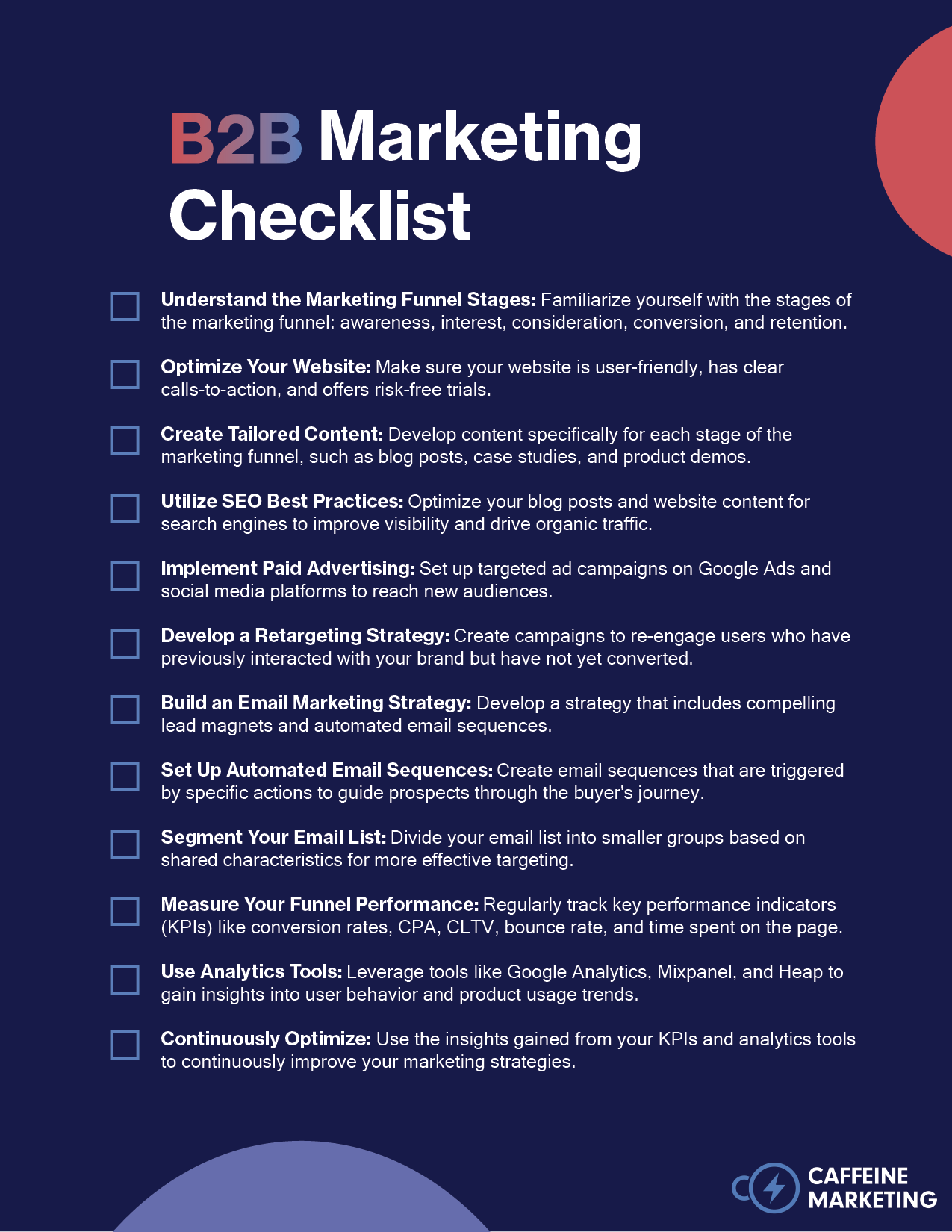
Want to create a killer marketing funnel? You need to know the different stages: awareness, interest, consideration, conversion, and retention. Each stage represents a critical touchpoint in the customer's journey, and understanding them allows you to tailor your marketing efforts effectively. It's like a roadmap to your customer's minds guiding you on how to move them from one stage to the next.
Use SEO, social media, content creation, and PR to attract potential customers who don't know you yet. This stage is all about visibility and reach, so think about where your potential customers spend their time online and make sure your brand has a presence there. It's not just about getting your name out there, but also about starting to build trust and credibility with your audience.
Provide valuable information that addresses their pain points through engaging blog posts and informative webinars. This is your opportunity to position your brand as a thought leader in your industry. By providing content that is both useful and interesting, you can start to build a relationship with potential customers and keep them engaged with your brand.
Create detailed product guides, publish case studies, and demonstrate thought leadership to showcase your solutions. At this stage, potential customers are comparing you to your competitors, so it's crucial to highlight what makes your product or service unique. Use this opportunity to address any potential objections or concerns that the customer may have.
Offer personalized demos, risk-free trials, and clear calls to action to turn prospects into paying customers. This is the moment of truth where you need to convince the customer that your product or service is the right choice for them. Make sure the process is as easy and frictionless as possible, and don't forget to communicate the value they'll get by choosing you.
Provide excellent customer support, update your products based on feedback, offer loyalty programs, and maintain an ongoing relationship. Remember, it's much more cost-effective to retain an existing customer than to acquire a new one. So, focus on keeping your customers happy and engaged; they'll become your brand's biggest advocates.
By incorporating these strategies, you can guide potential clients from initial awareness to becoming loyal advocates who refer new customers. This isn't a one-time process but a continuous cycle of attracting, engaging, converting, and retaining customers. Always test and optimize your strategies at each stage to maximize your marketing effectiveness.
Convert visitors into leads or customers with a well-designed website that has intuitive navigation, clear calls-to-action, risk-free trials, and engaging content. Remember, your website is the digital face of your business. It's crucial to make a great first impression and provide a seamless user experience. Also, consider implementing a chatbot or live chat feature to answer visitor queries in real-time, further enhancing their experience and increasing the chances of conversion.
Make your website easy to navigate with a clean layout, organized menus, consistent design elements, and mobile responsiveness. A well-structured website improves user experience and boosts your SEO ranking. Additionally, ensure your website loads quickly, as slow loading times can lead to higher bounce rates and lost potential customers.
Stand out visually with clear messages for CTAs like "Contact Us," "Download Now," and "Schedule Demo." Your CTAs should be action-oriented and create a sense of urgency. Experiment with different colors, sizes, and placements to see what works best for your audience. A/B testing can be a powerful tool in optimizing your CTAs.
Reduce friction in the decision-making process with limited-time promotions like free trials, discounts, or exclusive access to premium features. These incentives can be a powerful motivator for visitors to take the desired action. Remember, the perceived value of your offer should outweigh the perceived risk to encourage conversions.
Address the unique needs of potential customers with informative and engaging content at each stage of their buyer's journey, including blog posts, webinars, case studies, and tutorials. Content marketing is a powerful tool for nurturing leads and moving them down the funnel. Personalize your content based on the customer's stage in the buying journey to make it more relevant and engaging.
Remember to test and analyze the performance of each element on your site for continuous improvement.
Regularly review your website analytics to understand what's working and what's not. Use this data to make informed decisions and continuously optimize your website for better performance. Remember, the goal is to create a website that attracts visitors and converts them into customers.
The right content can educate potential clients about their problems while positioning your offerings as solutions. It's about creating a narrative that resonates with your audience and guides them toward your product or service. Remember, content marketing isn't just about selling; it's about building relationships and establishing your brand as a trusted resource.
Create content tailored specifically for each marketing funnel stage: awareness-stage blog posts addressing common pain points, case studies showcasing successful client outcomes during consideration, product demos highlighting features at conversion, and post-purchase support materials promoting retention.
Each stage of the funnel requires a different type of content. Tailoring your content to match the needs and mindset of your audience at each stage can significantly improve engagement and conversion rates. It's about providing the right information at the right time to guide your audience toward purchasing.
Create informative and engaging blog posts that address common challenges your target audience faces to generate awareness and attract new visitors to your website. These posts should be educational and provide value to your audience, positioning your brand as a thought leader in your industry. Also, consider guest posting on relevant industry blogs to expand your reach and attract more potential customers.
Use SEO best practices to optimize these pieces for search engines, ensuring they rank well and drive organic traffic.
SEO is a crucial part of content marketing. By optimizing your blog posts for relevant keywords, you can improve their visibility on search engines and attract more organic traffic. But remember, SEO isn't just about keywords; it's also about creating high-quality content that provides value to your audience.
Build credibility and trust among prospects considering a purchase by sharing actual results achieved by customers using your products or services. Case studies are powerful because they show your audience what they can expect if they choose your product or service. They provide concrete evidence of your product's value and can significantly influence the purchase decision.
Include specific metrics, testimonials, and visuals showcasing the benefits of choosing your solution over competitors' offerings.
When creating case studies, be specific. Include hard data, customer testimonials, and visuals to make your case studies more compelling. This adds credibility to your claims and makes your case studies more engaging and easier to understand.
Showcasing the functionality of your software through product demo videos is an excellent way to help potential customers visualize using it themselves. These demos should be clear, concise, and focus on the most valuable features of your audience. Remember, the goal is to show your audience how your product can solve their problems.
Highlight essential features relevant to their needs while emphasizing unique selling points (USPs) that set you apart from competitors.
When creating product demos, focus on the features that differentiate your product from competitors. Show your audience why your product is the best solution for their needs. This can significantly influence their purchase decision and increase conversion rates.
Provide resources that facilitate seamless onboarding to improve user experience and reduce the likelihood of churn due to frustration or confusion during the initial stages of adoption. These guides should be easy to understand and provide clear instructions on using your product. Remember, a positive onboarding experience can significantly improve customer satisfaction and retention.
Generate a comprehensive guide with step-by-step instructions, video lessons, or webinars to assist new customers in configuring and using your application competently. Consider using different formats like video lessons or webinars to cater to different learning preferences. This helps your customers get the most out of your product and shows them that you care about their success.
Here's an example of a great onboarding checklist to help you get started.
Incorporating content marketing across all stages of your marketing funnel is essential for guiding prospects through their buyer's journey while establishing trust in your brand.
By tailoring content for each stage, you'll create a powerful marketing funnel that drives growth for your B2B software and technology company.
Key Takeaway:
Tailoring content specifically for each stage to create a powerful marketing funnel for B2B software and technology companies is essential. This can be achieved by leveraging content marketing across the funnel stages, including creating blog posts, case studies, product demos, and post-purchase guides that address common pain points of potential clients while showcasing your solutions as unique selling points. Doing so will attract new visitors to your website and establish trust in your brand throughout the buyer's journey.
Targeted paid advertising campaigns on Google Ads and social media channels can help you reach new audiences quickly and generate immediate results.
Customize ads for each funnel stage and focus on keywords and ad copy that resonates with potential customers at different points in their buyer's journey.
Paid advertising can be a powerful tool for expanding your reach and accelerating growth. It allows you to target a specific audience and deliver personalized messages that resonate with them.
Bid on specific keywords related to your offerings to ensure that your ads appear when users search for relevant terms. Create distinct ad clusters to deliver customized messages based on a person's position in the decision-making cycle by targeting top, middle, and bottom funnel keywords.
This strategic approach increases your visibility on search engines and attracts more qualified leads, as your ads will appear to users actively seeking the solutions you offer.
Precisely target audiences based on demographics, interests, job titles, and industries on Facebook, LinkedIn, and Twitter. You can effectively educate potential clients, highlight testimonials or case studies, and offer promotions or exclusive discounts by using eye-catching visuals and persuasive ad copy tailored for each funnel stage.
Social media platforms provide an excellent opportunity to engage with your audience in real-time, respond to their queries, and gain insights into their preferences. This two-way communication can help build a strong relationship with your audience, fostering trust and loyalty towards your brand.
Show your content to users who have previously visited your website or engaged with your brand online but did not complete a desired action.
Retargeting campaigns serve as gentle reminders of the value your solutions provide, nudging potential customers closer to conversion. Moreover, retargeting campaigns can be highly effective as they focus on individuals who have already shown interest in your brand, making them more likely to convert.
By personalizing these campaigns based on the user's previous interactions with your brand, you can make your messages more relevant and compelling, increasing conversion chances.
Incorporating paid advertising into your marketing funnel strategy can help accelerate growth by reaching new audiences quickly while generating immediate results.
Customize ads for each stage of the buyer's journey to guide prospects effectively through their decision-making process and beyond.
Key Takeaway:
Paid advertising is a powerful tool to boost your marketing strategy and reach new audiences quickly. Customize ads for each funnel stage, experiment with different ad creatives and targeting options, and monitor campaign performance closely to maximize ROI. Incorporating paid advertising into your marketing funnel can help accelerate growth by guiding prospects effectively through their decision-making process.
A strong email marketing strategy can guide leads through sales with automated emails and lead magnets. This strategy helps in nurturing leads and maintaining a consistent line of communication with your audience. By providing valuable information and updates, you can keep your brand at the forefront of their minds, making them more likely to choose your solutions when they're ready to purchase. Furthermore, email marketing allows you to build a direct relationship with your audience, fostering trust and loyalty.
Offer valuable resources like e-books, whitepapers, templates, and webinars to capture contact information and demonstrate expertise. These resources should provide actionable insights your audience can apply to their businesses or roles.
By offering such valuable content in exchange for their contact information, you grow your email list and position your brand as a trusted resource in your industry. Remember, the more value you provide to your audience, the more likely they will engage with your brand and consider your solutions.
Automated email sequences triggered by specific actions can more efficiently guide prospects through the buyer's journey. These sequences, often called drip campaigns, allow you to deliver the right message at the right time based on the user's behavior or stage in the buying process.
For instance, a welcome email can be sent immediately after a user subscribes to your newsletter, followed by emails providing valuable content and introducing your offerings. This automation saves you time and ensures a consistent and personalized experience for your prospects, increasing the likelihood of conversion.
Divide subscribers into smaller groups based on shared characteristics to send tailored messages that resonate with specific segments.
Popular segmentation methods include geographic location, past purchase history, website activity, and expressed interests.
Incorporating these strategies within your email marketing efforts will help grow your subscriber base and foster stronger relationships with potential clients.
{{b2b-webinar="/cta"}}
Regularly measuring your marketing funnel's performance is crucial for continuous improvement, so keep an eye on metrics like conversion rates, CPA, CLTV, bounce rate, and time spent on the page.
These metrics provide insights into how effectively your strategies drive users through the funnel and where there might be room for improvement. By analyzing these metrics, you can identify bottlenecks in your funnel and make data-driven decisions to optimize your strategies.
Use different KPIs to evaluate success at each funnel stage, such as website traffic and social media engagement for awareness, lead generation and email open rates for interest and consideration, and sales conversions and customer retention rates for the bottom of the funnel.
Each funnel stage has unique objectives and requires different KPIs to measure success. By tracking these KPIs, you can better understand your audience's behavior at each stage and tailor your strategies to drive them toward conversion.
Utilizing services such as Google Analytics, Mixpanel, and Heap can give useful information about user conduct and item utilization trends; therefore, selecting the correct one for your requirements is important.
These tools provide a wealth of data to help you understand your audience's behavior, preferences, and interactions with your brand. By leveraging these insights, you can refine your strategies to meet your audience's needs better and improve their experience, ultimately driving more conversions and boosting your ROI.
Use the insights gained from your KPIs and analytics tools to decide which strategies need tweaking or overhauling entirely. This process of continuous improvement is crucial in maintaining a high-performing marketing funnel. By closely monitoring your metrics, you can identify underperforming areas of your strategy and make necessary adjustments to improve their effectiveness.
Remember, marketing is a dynamic process that requires constant optimization. Celebrate your successes, learn from your failures, and strive for improvement. Doing so ensures that your marketing funnel continues to drive growth for your B2B software and technology company.
A Customer Relationship Management (CRM) system is like a digital address book for your business, but it does much more than store contact information. It helps you keep track of all your interactions with customers and potential customers, making it easier to manage and nurture leads.
CRM systems allow you to record every interaction with potential customers, providing a comprehensive view of their journey. This information can be invaluable in understanding their needs, preferences, and behaviors, enabling you to tailor your marketing efforts accordingly. Regularly review this data to identify trends and opportunities for engagement.
With a CRM system, you can segment your audience based on various criteria such as their industry, job role, past interactions, and more. This allows you to deliver personalized marketing messages that resonate with each segment. Remember, personalized marketing can significantly improve engagement and conversion rates, making it a crucial strategy in your marketing funnel.
CRM systems can automate follow-ups, ensuring potential customers receive timely and relevant communications. This saves you time and ensures consistent engagement with your leads. Set up automated email sequences or reminders for personal follow-ups based on the lead's behavior or stage in the funnel.
Social proof is when people follow what others are doing because they think it's right. In marketing, we use social proof to help convince potential customers to buy our products or services. This can be done by showing them testimonials, reviews, or case studies from other customers who have had a positive experience with our brand.
Testimonials and reviews provide real-world evidence of your product's value, building trust and credibility with potential customers. Include these on your website, in your marketing materials, and even in your email campaigns. Remember, prospects are more likely to trust your brand if they see that others have had positive experiences.
Case studies examine how your product or service has helped others, making them powerful social proof. Create case studies highlighting the problem, solution, and results, and include specific data to add credibility. Share these case studies on your website, social media, and other marketing channels to showcase your product's value.
User-generated content, such as social media posts or blog articles written by your customers, can serve as authentic social proof. Encourage your customers to share their experiences and consider featuring their content in your marketing efforts. This provides social proof and strengthens your relationship with your customers by valuing their contributions.
A/B testing is like a science experiment for your marketing materials. You create two versions of something (like a webpage or an email), change one thing (like the color of a button or the wording of a headline), and then see which version gets a better response from your audience. This helps you make decisions based on data, not just guesses and can help you improve your marketing over time.
A/B testing involves creating two versions of your marketing materials and testing them to see which performs better. This could be two different email subject lines, two different landing page designs, or any other element of your marketing. By conducting A/B tests, you can identify what resonates best with your audience and optimize your materials accordingly.
Once you've conducted an A/B test, it's crucial to analyze the results and make data-driven decisions. Look at metrics like click-through rates, conversion rates, and time spent on page to determine which version was more effective. Use these insights to refine your marketing materials and improve their performance.
A/B testing is not a one-time process but a part of continuous improvement. Regularly conduct A/B tests on different marketing elements to continually optimize your funnel. Even small improvements can significantly impact your overall conversion rates and ROI.
Optimizing your website for conversions, leveraging content marketing, utilizing paid advertising campaigns, building an email marketing strategy, and measuring and analyzing funnel performance is crucial for any B2B software and technology company.
By following these steps, you can generate brand visibility, captivate potential customers' attention, showcase your products or services as solutions, turn prospects into paying customers, and ensure customer satisfaction for repeat business.
Remember, each step builds on the previous one, so don't skip any steps if you want maximum results.
Need help to grow your leads? Let us help you. Find a time to meet with our team here
